Two queues
Vehicles with a booked time slot are sorted by slot, vehicles without a booking by waiting time. Anyone who turns up late for their slot, or without one at all, does not drop out of sight because of it.
Who is on the yard, how long they have been waiting, who is handling them.
Hofboard is a handling board for the works yard: one screen showing who is there, how long they have been waiting and who is handling them. It keeps three separate times per vehicle – early, waiting, handling – and records them, so that a demurrage claim becomes verifiable instead of contested. Currently in beta, five slots.
At most yards, handling runs on shouting and paper. The driver reports at the gate, someone notes the plate on a printout, and whoever happens to be nearby decides who goes next. Nobody knows exactly how many vehicles are waiting, let alone how long the first one has been standing there. The result is questions in every direction: dispatch rings the warehouse, the warehouse asks at the gate, the driver asks for the third time. And when a demurrage claim lands on the desk weeks later, it is one account against another – the note from back then is long gone, and nobody can prove when the vehicle actually arrived and when it was handled.
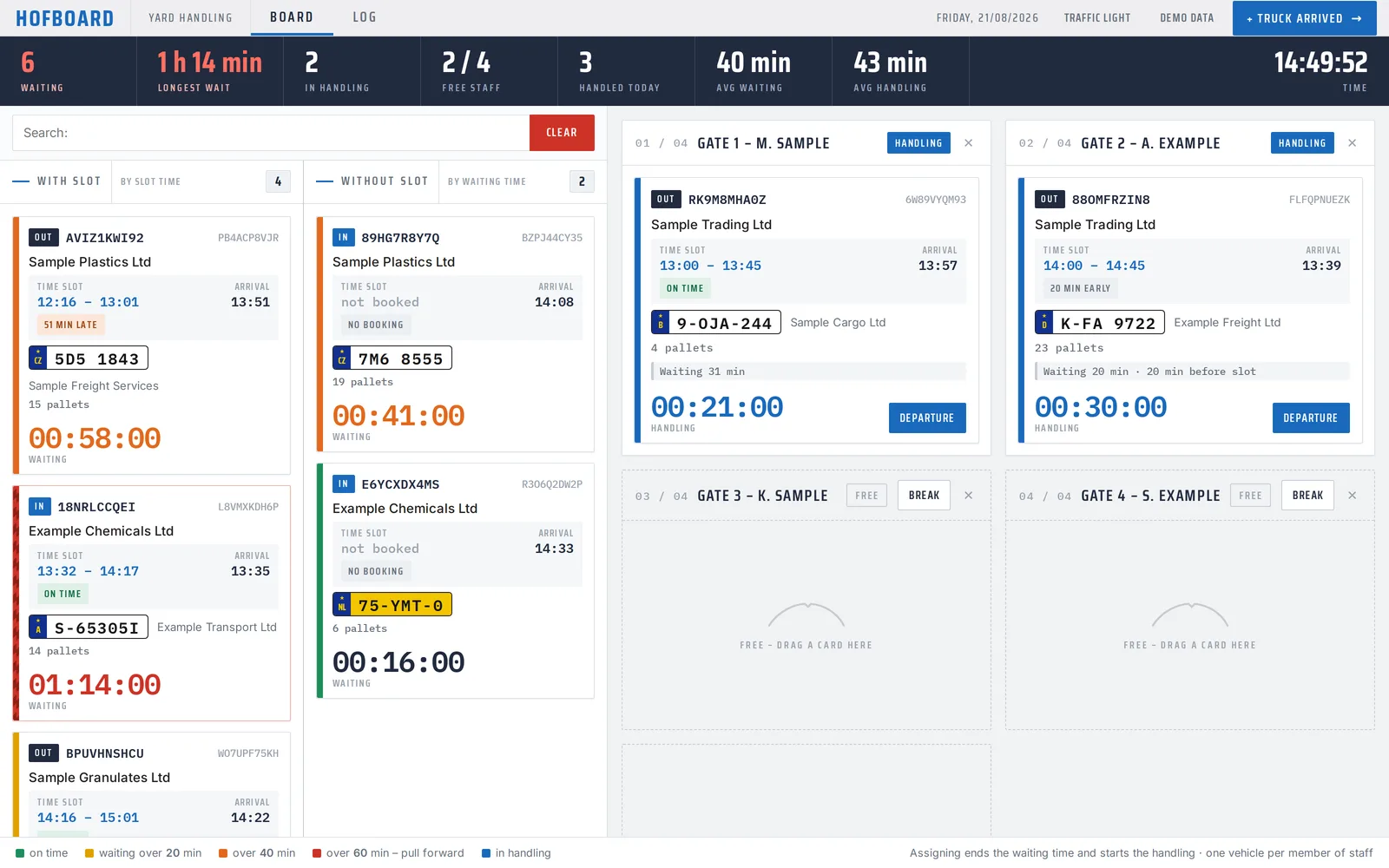
Hofboard puts the yard on one screen. On the left are two queues: vehicles with a booked time slot, sorted by slot, and vehicles without a booking, sorted by waiting time. On the right are the gates, one vehicle per member of staff. Assignment is a drag: the card moves out of the queue onto a gate, which ends the waiting time and starts the handling. A traffic light colours the cards by waiting time – on time, over 20 minutes, over 40 minutes, over 60 minutes and therefore to be pulled forward. A metrics bar runs along the top: how many are waiting, how long the longest one has been waiting, how many are being handled, how many staff are free, how many were handled today, plus the averages for waiting and handling.
Vehicles with a booked time slot are sorted by slot, vehicles without a booking by waiting time. Anyone who turns up late for their slot, or without one at all, does not drop out of sight because of it.
A card is dragged onto a gate, that is all there is to it. The assignment ends the waiting time and starts the handling; one vehicle runs per member of staff. Who is free right now is shown next to it – the yard decides the order, not chance.
Every card carries its running waiting time and a colour to go with it: on time, over 20, over 40, over 60 minutes. The last one in the row becomes visible before he complains – not afterwards.
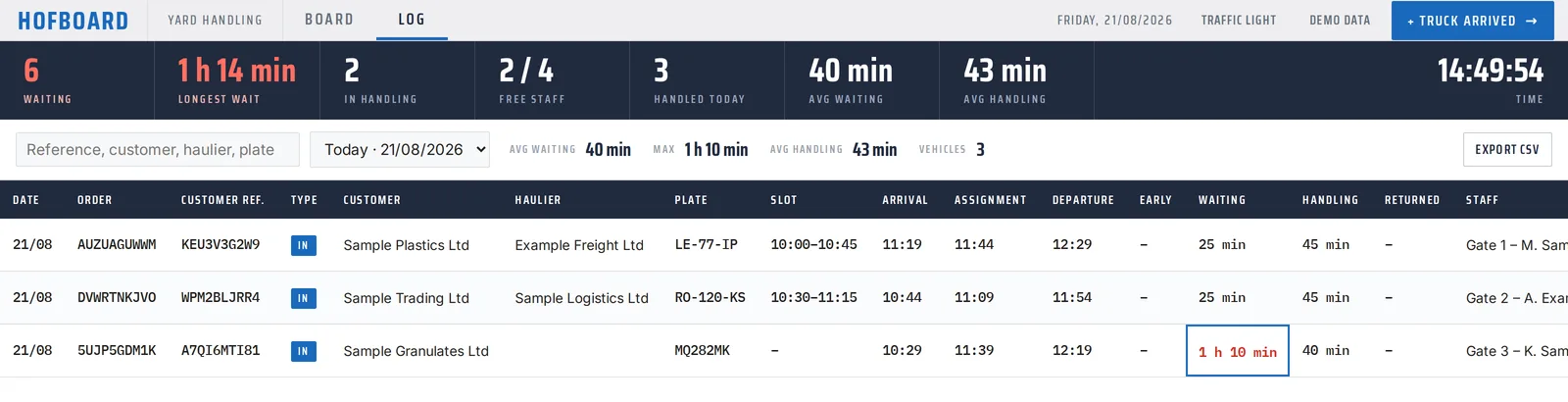
Date, order, customer reference, type, customer, haulier, plate, time slot, arrival, assignment, departure and the three times – available per day and exportable as CSV, for analysis or as an attachment to a claim.
Waiting, longest waiting time, being handled, free staff, handled today, average waiting, average handling. The same numbers for everyone looking at the screen – at the gate as much as in dispatch.
Alongside the board there are two further views. The first is a display for a screen on the yard or in the hall: both queues and the state of the gates, legible from several metres away and without controls. It shows the plate, the customer and the waiting time – order and reference numbers stay at the workplace, where they belong. The second runs on the device on the forklift, on a tablet as on a phone: the member of staff sees the vehicle assigned to them, reports it finished once the handling is done, and takes their break themselves. A break is only possible once the vehicle has been reported finished – one member of staff, one vehicle, here as well. What gets reported is reported where the work happens, rather than second-hand and later.
Most reports know a single duration: arrival to departure. Nothing can be settled with it, because that one number mixes everything together – including the time a vehicle spent on the yard of its own accord, ahead of its slot. Hofboard keeps three separate accounts per vehicle instead. “Early” is the time between the arrival and the start of the time slot – or the assignment to a gate, if the vehicle gets its turn before that. “Waiting” starts with the time slot – or with the arrival, if none was booked or the vehicle came later – and ends when it is assigned to a gate. “Handling” starts with the assignment and ends with the departure. All three numbers sit side by side in the log, in columns of their own. Only kept apart can they be attributed: one belongs to whoever arrives early, the other to the yard.
One vehicle from the log: time slot 07:00 to 07:45, arrived at 06:17, assigned at 06:42, departed at 07:27. It stood on the yard for 70 minutes. Hofboard records 25 minutes “early”, 0 minutes waiting and 45 minutes handling: the vehicle did not wait a single minute, it was there ahead of time and was let onto a gate before its slot had even begun. A single stopwatch would have counted 70 minutes and could not have said of what.
Demurrage is rarely contested because someone is being untruthful – it is contested because nobody can prove anything. With the three accounts it is on record for every vehicle when it arrived, when it was assigned, when it left, and how much of that went onto the “early” account. A vehicle that drives onto the yard half an hour before its slot has not waited that half hour. And because every started hour from the second one onwards is charged, a single minute often decides whether a claim arises at all. The log can be exported as CSV and held against a claim. The other way round, you see just as clearly where the waiting really was too long – and at which gate.
Assuming:
Possible saving: 5 × 220 × €45 = €49,500 a year
An example calculation with its assumptions on the table, not a promise. Demurrage does not accrue by the minute, it jumps: every started hour from the second one costs €45, whether it is used up or not. What saves money is therefore not being a few minutes quicker everywhere, but pulling a vehicle forward before the next hour begins – which is exactly why the traffic light turns at 60 minutes and says “pull forward”. The first five rows are operating figures, the last one is the assumption at issue. Every yard has to redo this calculation with its own numbers – after two weeks of the log, they are on the table.
Hofboard does not replace Cargoclix – it is the layer after it. Slot booking stays where it is; Hofboard shows what becomes of it on the yard and measures the times the booking never sees. The same goes for the transport management system: order, customer reference, customer, haulier and type are on the card at the gate, so that nobody has to ask there. Both are optional, and both directions occur: a vehicle without a booking still drives onto the yard and gets a card in the second queue; a booked arrival that nobody turns up for stays visible instead of disappearing. What the integration looks like in your case we clarify before the setup – the systems are CarLo and Cargoclix, the routes to them are not always the same.
Hofboard runs as a Docker container in your own network, on a server that belongs to you – or, if you prefer, with us as a hosted service. Run in your own network it needs no connection to the outside: it hangs on nobody else’s cloud, and if the internet line fails, the board carries on. That variant is at the same time the simplest one in data-protection terms, because what is created along the way – plates, names, times – never leaves the building in the first place. Several workstations see the same state: what is assigned at the gate is on the screen in dispatch at the same moment, without anyone passing a list along.
Hofboard is in beta. That means the application is built and agreed with one operation, but it is not finished, and we would rather say so beforehand than afterwards. Whoever takes a beta slot gets the setup in their own house, a named contact instead of a ticket system, and changes that come out of daily operation implemented with priority. In return we expect your experience: what is missing, what gets in the way, what works differently than expected. Five slots – no more, because we want to listen to every one of them.
Beta terms: 50 % off during the beta, 30 % permanently for the first five operations – based on the later list price, in return for a named reference after three months. There is no list price today.
The beta has no end date – it ends when the points that come up in it have been dealt with. General availability is planned for early 2027.
No. Cargoclix hands out the time slot, Hofboard shows what becomes of it on the yard – who actually arrived, how long they wait, who handles them. The two do not stand side by side but one after the other: booking first, yard second. An existing slot booking is therefore no argument against Hofboard, it is the better starting point.
No. Order data makes the cards at the gate more complete – order, customer reference, customer, haulier – but it is not required. Without an integration you enter an arriving vehicle by hand via “truck arrived”; the timing and the log work just the same.
Yes. The usual route is a Docker container on a server in your network; there the board keeps running even if the internet line fails. Anyone who would rather not provide a server for it gets Hofboard as a hosted service with us – the choice changes nothing about the application, only where the data sits.