(01) PROCESS AUTOMATION · n8n
Process automation
Do away with repetitive tasks, connect the steps – from invoice capture to complete order processing without manual intervention.
n8nAPIWorkflow designRPA
Your business runs – we make it measurably more efficient. Process automation, AI integration and data connectivity, not off the shelf but built exactly for your company.
Do away with repetitive tasks, connect the steps – from invoice capture to complete order processing without manual intervention.
AI where it creates real value: document recognition, classification, data extraction – on-premise, on your own hardware.
Connecting systems that don’t talk to each other: EDI clearing, API connections, format conversion – any format into any other, as far as both carry the same depth of information. Reliable and scalable.
Before we build, we think. Processes aren’t simply digitalised – they’re rethought, with honest analysis and a feasible roadmap.
Who is on the yard, how long they have been waiting, who is handling them.
Hofboard is a handling board for the works yard: one screen showing who is there, how long they have been waiting and who is handling them. It keeps three separate times per vehicle – early, waiting, handling – and records them, so that a demurrage claim becomes verifiable instead of contested. Currently in beta, five slots.
See Hofboard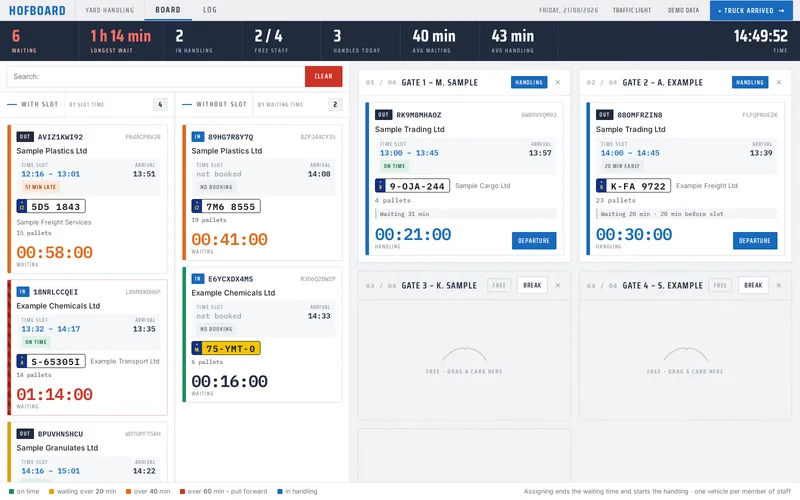
Understand before we build: current processes, systems and bottlenecks captured on site. For larger projects this is exactly the potential analysis – credited against the project when you commission it.
Result: Current-state process map & bottleneck listRethought, not just digitalised – with effort, benefit and clear prioritisation.
Result: Target architecture & roadmapCrafted with precision, tested in steps and cleanly put into operation.
Result: Productive solution & documentationIt doesn’t end at go-live: monitoring, maintenance and improvement in ongoing operation.
Result: Stable operation & evolutionCargoclix connection to an ERP (mid-sized film manufacturer) and a WMS (freight forwarder/logistics provider) – data flows automatically instead of manually.
Autonomous transport-order handling on the Transporeon platform: automatic order acceptance and time-slot booking per customer rules; for unclear cases, a natural-language query to the dispatcher via email/WhatsApp.
Incoming invoices: AI classification & indexing with local master data (supplier accounts, cost centres) – fully on-premise, without the cloud.
Anonymised excerpts from real projects. Client names and figures on approval.
It depends heavily on scope. A quick win – a clearly defined, recurring task – is often in production within a week and still removes noticeable manual work. Where several departments and systems are involved, four to eight weeks is more realistic. The biggest factor is usually not the technology but how quickly people on your side answer questions and provide access.
In four phases: analysis, concept, delivery, operation. After the analysis you receive an effort estimate with clear priorities before anything is built, so you decide on solid numbers rather than on assumptions. Throughout, you talk to the people who actually build your solution, not to a ticket system.
If you want it to, entirely. We run automation and AI processing on your own hardware, so documents and master data never leave the company. Incoming invoices, for example, are classified by local language models against your own supplier and cost-centre data — in-house and without any cloud connection.
No. We connect the systems you already have rather than replacing them: ERP, WMS, archive and industry-specific software stay where they are. We work at the interfaces – wherever someone currently moves data from one system into another. Replacing a system can make sense, but it is a separate decision and not a precondition for automation.
EDIFACT is a United Nations standard for exchanging business documents electronically between companies. Orders (ORDERS), despatch advices (DESADV) and invoices (INVOIC) are broken down into standardised segments that both sides can read automatically. In retail, manufacturing and logistics, EDIFACT is often a precondition for becoming a supplier at all.
Usually three things: a format (most often EDIFACT, sometimes XML or CSV), a transport channel (AS2, OFTP2, SFTP or a platform such as Cargoclix or Transporeon), and a mapping that translates the fields in your systems into the message. We deliver all three parts and connect them to your ERP or WMS, so you never have to run an EDI system yourself.
The nature of the data decides, not the technology. For documents containing personal data, prices or design information we recommend local models on your own hardware; for uncritical tasks a cloud model is often faster to introduce and cheaper. For document recognition, classification and data extraction, locally hosted models are generally sufficient today. With a cloud solution, operation naturally depends on the provider; an on-premise installation keeps running in your own house regardless.
When it replaces recurring, rule-based work, our projects usually pay for themselves in under a year – for quick wins considerably faster. Automation is not worth it for processes that change constantly, occur rarely, or are in truth an organisational problem: then changing the process is cheaper than automating it. When we reach that conclusion, we say so and advise against it.
Strategic process design and technical delivery – neither without the other. Over 15 years of IT expertise, from EDI to AI. An honest assessment instead of PowerPoint.
Clear scope, transparent effort. If an automation isn’t worth it, we say so openly – and advise against it.
Cargoclix, Transporeon, EDIFACT, on-premise AI: systems we built that run today.
You talk to the people who actually build your solution.
Thirty minutes, remote, free of charge. We want to know which systems you use, where work is still done by hand today, and what bothers you most. We cannot give real advice in thirty minutes – anyone who claims otherwise is selling. It ends in one of three paths:
A free intro call and an honest first assessment.